An Analysis of Investor Activity Across Virginia
October 5, 2026

Institutional investor activity is an increasingly discussed issue in the conversations about housing supply shortages. To understand its overall impact, we quantify the share of investor ownership of residential properties in Virginia by analyzing parcel level data.
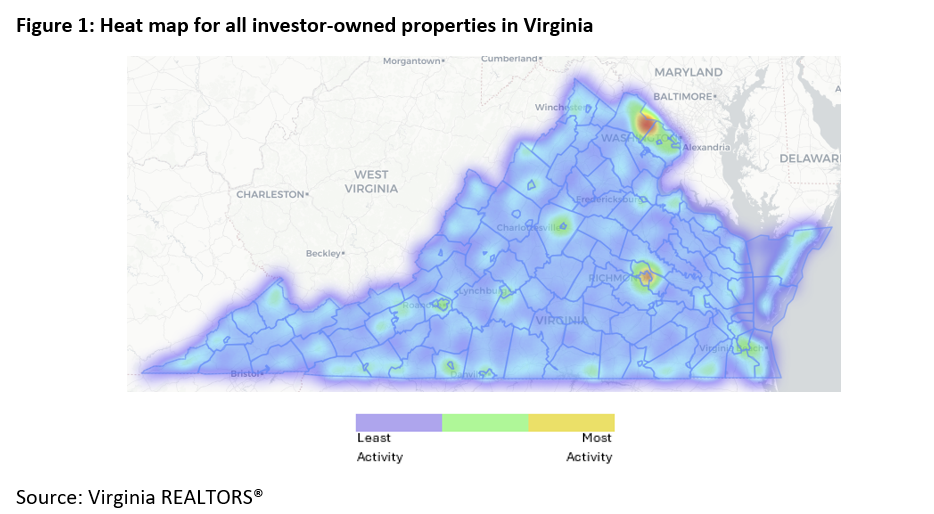
We define investors as entities (individuals, companies, corporations, etc.) who purchase a home and are not residing in it. We find that 11.3% of the residential properties across the Commonwealth are owned by investors, most of which are individuals and small mom-and pop-investors. This share for Virginia has gone up since the last time we conducted the study in 2023, when investor-owned properties made up 10.2% of the residential share. This modest but steady increase mirrors a broader national pattern wherein investor ownership activity has remained relatively steady even as overall home sales have softened in some markets.
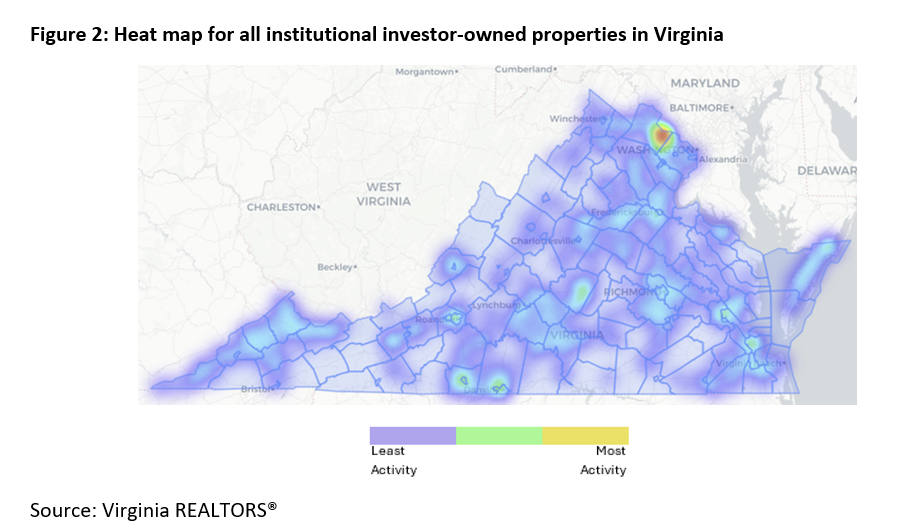
Institutional investors account for a small portion of total residential ownership. We define institutional investors as entities that own more than 100 properties, which is consistent with the threshold used in recent national research distinguishing large-scale corporate ownership from smaller investor activity. In Virginia, institutional-investor-owned properties made up just 1.2% of residential properties. This share is broadly in line with national findings that large institutional investors typically account for only about 1% of total single-family housing stock, even in markets that receive significant media attention for investor activity.
Investor activity is unevenly distributed across Virginia’s metro regions.
Investor activity levels vary across different Virginia metros. This concentration pattern is consistent with national research showing that investor activity tends to cluster in specific submarkets rather than distributing evenly across a region, often reflecting differences in housing stock age, price point, and rental demand. Furthermore, investor activity is more heavily weighted toward suburban and exurban housing stock than toward the city’s core.
The three metro regions with the highest share of investor activity in their residential markets – Charlottesville (18.4%), Harrisonburg (18.4%), and Blacksburg (15.6%) – all have investor-owned properties concentrated in college towns. The investor activity in these areas is largely driven by small, mom-and-pop investors (defined as those owning fewer than 10 properties). Hampton Roads (9.8%) ranks the lowest in terms of the share of investor activity in its residential market. On the other hand, institutional investor activity is the highest in Northern Virginia (2.3%) among Virginia metros, followed by Winchester (1.5%), and Charlottesville (1.3%). Hampton Roads (0.3%) has the lowest share of institutional investors in its residential market compared to other metro areas within Virginia.
Potential implications of the 21st Century ROAD to Housing Act
The 21st Century ROAD to Housing Act, signed into law July 2026, is the first major bipartisan federal housing package since the 1990s. It would restrict institutional investors from buying single-family homes (with a build-to-rent exception) and create a HUD renter outreach resource. While institutional investors certainly have a presence across the Commonwealth, Virginia’s investor activity skews smaller and regional. So, it is the supply-side provisions of the law, which include expanding certain programs such as CDBG/HOME programs and cutting regulatory barriers, that may matter more in moving the needle on Virginia’s supply shortage issue than the investor restriction provisions.
For more information on housing, demographic and economic trends in Virginia, be sure to check out Virginia REALTORS® other Economic Insights blogs and our Data page
You might also like…
RPAC: Purpose, Impact, Balance
By D.J. Spiker - October 5, 2026
If you’ve ever wondered what RPAC actually does, you’re not alone. RPAC, the REALTORS® Political Action Committee, has helped REALTORS® participate in the political process since 1969. It… Read More
From Pending to Closing: Why Housing Deals Fall Through
By Abel Opoku-Adjei - September 8, 2026
A home going under contract is an exciting milestone for buyers and sellers; however, a pending sale doesn’t always mean the sale will close. Between an accepted offer and closing day, various… Read More
What the New Federal Housing Law Means for Virginia Real Estate Professionals
By Sejal Naik - August 3, 2026
After years of back-and-forth in Congress, the 21st Century ROAD to Housing Act is now law. Passing with big bipartisan majorities, it took effect on July 11,… Read More