From Pending to Closing: Why Housing Deals Fall Through
September 8, 2026
A home going under contract is an exciting milestone for buyers and sellers; however, a pending sale doesn’t always mean the sale will close. Between an accepted offer and closing day, various challenges can emerge, potentially causing delays or even ending the deal.
Virginia REALTORS® has been tracking this experience through our monthly REALTOR® surveys. Since March 2024, we have asked respondents whether they dealt with a pending sale that ultimately failed to close. The results show that failed pending transactions remain a regular part of the housing market.
In August 2026, 34% of survey respondents reported dealing with a failed pending sale, the highest share since we began tracking this question in March 2024. This was also an increase from 26% in both June and July.
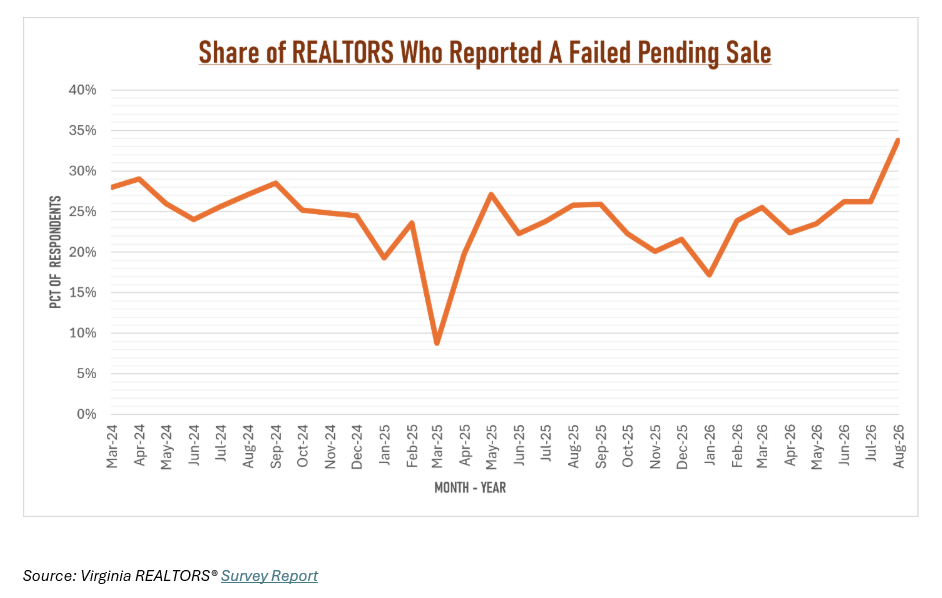
While one month doesn’t always indicate a long-term trend, the recent uptick prompts us to ask: What factors can prevent a home, already under contract, from reaching closing?
What Is Causing Pending Sales to Fall Through?
Our survey asks REALTORS® who experienced a failed pending sale to identify the issues that caused the transaction to fall through. Over time, inspection issues have been the most commonly reported reason, followed by buyers being unable to obtain mortgage approval.
More recently, however, another obstacle has been showing up more frequently. In 2026, respondents have increasingly reported buyers being unable to sell their current home as a reason transactions failed. This is an important trend to watch as buyers navigate a housing market where selling an existing property may be an important step toward completing their next purchase.
Inspection Issues
Inspection issues have consistently been the most common reason reported in our survey. Even after an offer is accepted, a home inspection can uncover problems that weren’t apparent when the buyer first viewed the property.
Issues involving the roof, electrical system, plumbing, foundation, HVAC system, or water damage are just some of the concerns that may emerge. Depending on the contract, buyers may request repairs, credits, or other remedies. If significant problems are uncovered or the buyer and seller cannot reach an agreement, the transaction could fall through.
Mortgage Approval
Mortgage approval remains a major obstacle cited by REALTORS®. Although buyers can obtain a mortgage preapproval before making an offer, this does not ensure final loan approval. Lenders keep reviewing a borrower’s finances during the loan process.
Any changes in income, debt, credit, employment, documentation, or other factors could impact the borrower’s qualification. If the buyer cannot secure financing, the transaction might not close.
Selling a Current Home Is Becoming a Bigger Factor
One notable development in our 2026 survey results is the growing number of respondents citing difficulty selling a buyer’s current home as a reason for a failed pending sale.
For some buyers, purchasing their next home depends on successfully selling the one they already own. Proceeds from that sale may be needed for a down payment or other costs associated with their next purchase. A buyer may also be unwilling or unable to carry the costs of two homes simultaneously.
If the existing home takes longer to sell or the deal falls through, it can trigger a chain reaction. The buyer might then be unable to proceed with their current purchase.
Title Troubles
Before a property changes hands, a title search typically identifies issues that could affect ownership or the transfer of the property.
Unpaid liens, ownership disputes, errors in public records, or other title defects can complicate a transaction. Many title issues can be resolved before closing, but more complicated problems can cause delays and, in some cases, prevent the transaction from moving forward.
Job Loss
Job loss can pose a significant obstacle, especially when a buyer is relying on financing. Employment status and income are crucial factors affecting mortgage qualification.
If a buyer loses their job or experiences a substantial income change before closing, the lender might have to review the loan. A sudden drop in income could also lead the buyer to reassess whether buying a home is still financially practical.
From Pending to Closed
Many steps exist between accepting an offer and handing over the keys. Our survey indicates that inspection issues and mortgage approval continue to be common hurdles, while difficulty selling an existing home has gained prominence in 2026.
Additionally, August’s data revealed that approximately one in three respondents experienced a failed pending sale, the highest since tracking began. Whether this trend persists remains uncertain, but it underscores the importance of monitoring pending transactions in the coming months.
For buyers and sellers, understanding the potential events between an accepted offer and closing can help them prepare more effectively. Meanwhile, REALTORS® can gain valuable insights into the challenges their clients face in today’s housing market.
You might also like…
What the New Federal Housing Law Means for Virginia Real Estate Professionals
By Sejal Naik - August 3, 2026
After years of back-and-forth in Congress, the 21st Century ROAD to Housing Act is now law. Passing with big bipartisan majorities, it took effect on July 11,… Read More
Highlights from the 2026 JCHS State of the Nation’s Housing Report
By Dominique Fair - July 6, 2026
Every year the Joint Center for Housing Studies at Harvard University (JCHS) releases their State of the Nation’s Housing Report, showing where the housing market stands and how… Read More
Tracking Virginia’s Migration Flows Across the Country
By Abel Opoku-Adjei - May 29, 2026
There are many reasons why people decide to move. Migration patterns demonstrate how affordability, economic opportunity, and lifestyle choices influence population shifts nationwide. Virginia continues to be a… Read More