Highlights from the 2026 JCHS State of the Nation’s Housing Report
July 6, 2026

Every year the Joint Center for Housing Studies at Harvard University (JCHS) releases their State of the Nation’s Housing Report, showing where the housing market stands and how it is impacting homeowners and renters. Let’s look at five key takeaways from the report.
Household Growth is Slowing, Particularly Among Young Adults
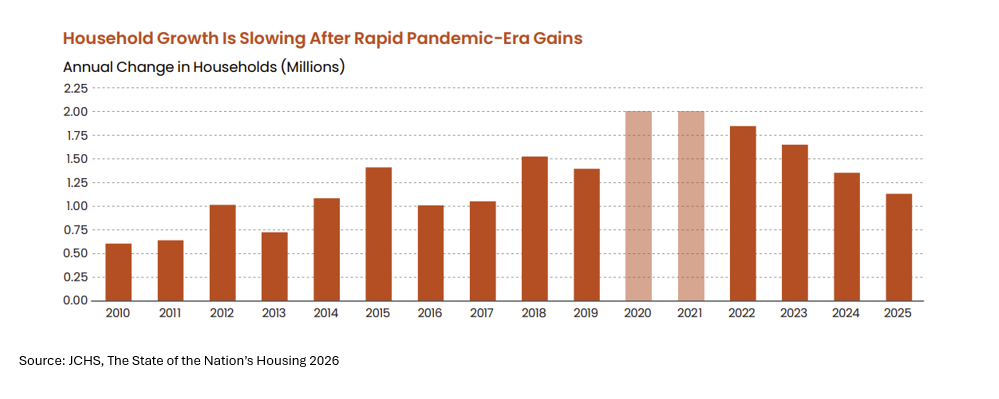
In the U.S., annual household growth fell for the third consecutive year going from an average of 2.0 million in 2020 and 2021 to 1.1 million in 2025. Younger adults were a driver of household formation in the early years of the pandemic as lower interest rates coupled with higher incomes led to more households. By 2022, 33% of adults 18-34 years old had become householders. This changed in 2024 as student loan debt delinquencies began to climb up and the average monthly hiring rate dropped to its lowest level since 2012. Economic uncertainty has also contributed to many young adults delaying home buying or moving in general.
Older Households Continue to Shape the Market
The number of older adults (65 years and older) in the U.S. went from 48 to 65 million over the last decade, accounting for 19% of the total population. Per the JCHS, the number of households headed by this cohort is projected to increase by 26% from 2025 to 2045. Household growth will also begin to slow as older populations die or move out of their homes. Over the next 10 years, householders 65 years and older are predicted to fall by 1.4 million annually. Although adults under 35 years old are expected to add 2.4 million households within the same period, it will not be enough to offset the losses from older generations.
Existing Inventory Grows as New Construction Becomes Costly
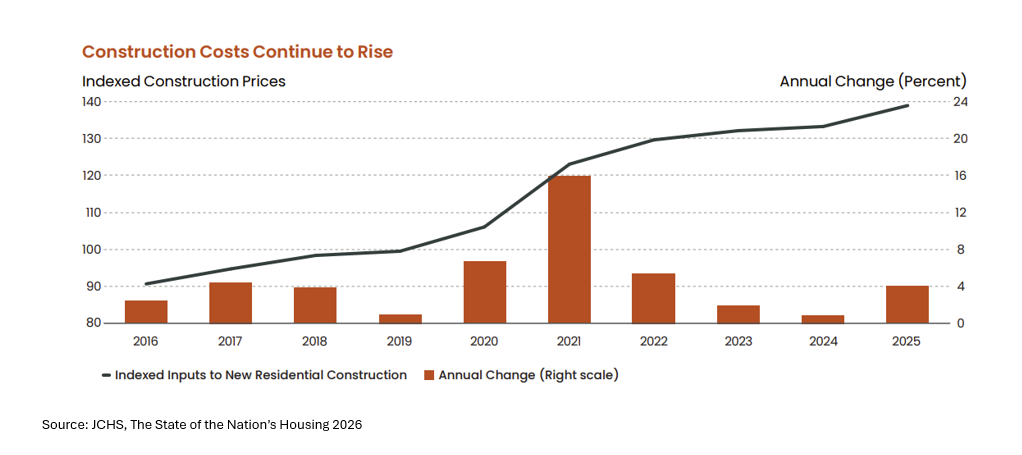
Nationwide, inventory levels continue to rise with 1.39 million existing homes on the market in March 2026, up 5% from a year earlier. While existing inventory is gaining, new construction has slowed, with single family starts down 7% in 2025. New homes are becoming increasingly unaffordable for first-time buyers, with a recent analysis finding that in March 2026, only 23% of listings in the U.S. were affordable to a household making $75,000 or less, down from 49% in 2019. Builders have been offering rate buydowns and low-cost housing options but the price of inputs for residential construction, which has risen 40% since January 2020, has made it difficult to build more affordable housing options.
Home Price Growth Slowed but is Still Too High
Recently, home price growth cooled in the U.S., up just 0.7% in February 2026, down from 4% the previous year. Despite this decrease, prices are still 54% higher than they were in January 2020, or almost 25% higher after adjusting for inflation. At the regional level, 72 out of the nation’s 100 largest markets saw prices grow by more than 50% between 2020 and 2026. The price to income ratio, which helps measure housing affordability, went up for the fifth straight year to 4.7, meaning that the median home price costs nearly five times the median household income. Elevated prices have also impacted home sales, which averaged 4.1 million in the first quarter of 2026, essentially unchanged from 2025.
Increased Housing Costs Impeding Homeownership
Per the Census Bureau, 20.7 million owner households were cost burdened in 2024, increasing by 4.0 million since 2019. Higher homeownership costs have contributed to rising burden levels across the U.S. For example, to afford a home at last year’s median price ($409,000) buyers would have needed $14,300 for a 3.5% down payment or $81,700 for a 20% down payment. Another factor is mortgage payments, with owners paying $2,420 for a median price home last year, up from $1,240 at the end of 2020. Homeowners have also seen property taxes rise 31% over the last six years as well as monthly insurance premiums which are up 72%. These factors have led to a decrease in homeowner household growth going from 541,000 in 2024 to 234,000 in 2025, the slowest it has been in the last 10 years.

For more information on housing, demographic, and economic trends in Virginia, be sure to check out Virginia REALTORS® other Economic Insights blogs.
You might also like…
An Analysis of Investor Activity Across Virginia
By Sejal Naik - October 5, 2026
Institutional investor activity is an increasingly discussed issue in the conversations about housing supply shortages. To understand its overall impact, we quantify the share of investor ownership of… Read More
RPAC: Purpose, Impact, Balance
By D.J. Spiker - October 5, 2026
If you’ve ever wondered what RPAC actually does, you’re not alone. RPAC, the REALTORS® Political Action Committee, has helped REALTORS® participate in the political process since 1969. It… Read More
From Pending to Closing: Why Housing Deals Fall Through
By Abel Opoku-Adjei - September 8, 2026
A home going under contract is an exciting milestone for buyers and sellers; however, a pending sale doesn’t always mean the sale will close. Between an accepted offer and closing day, various… Read More