Pulse Check on Virginia’s Metro Housing Markets
September 5, 2025

Virginia’s housing market is moving through one of its busiest seasons, yet the market has been sluggish with no signs of picking up as the summer comes to a close. Both buyers and sellers are impacted by economic uncertainty, high mortgage rates, and affordability challenges that continue to weigh on them. This trend is reflected nationwide, with listings taking longer to sell during this period. Let’s examine how inventory and sales have changed in Virginia.
Inventory
July saw more sellers enter the Virginia market, driving month-end inventory statewide to 24,429, an increase of 5,267 active listings compared to this time last year (+27.5%). Although this time of year is typically a busy period, listings have been on the market longer than in the previous year. In July, listings in Virginia were on the market for a median of 15 days, up nearly a week from the prior year. Listings have risen statewide for about two years, but there’s been a notable influx in 2025
Most of Virginia’s metro areas saw an increase in active listings at the end of July. The most notable increases were seen in Roanoke (+41.8%), Hampton Roads (+34.4%), and Harrisonburg (+39.3%). Both Winchester, down 15.4%, and Danville, down 6.0%, experienced a year-over-year decline in inventory compared to the end of last July.

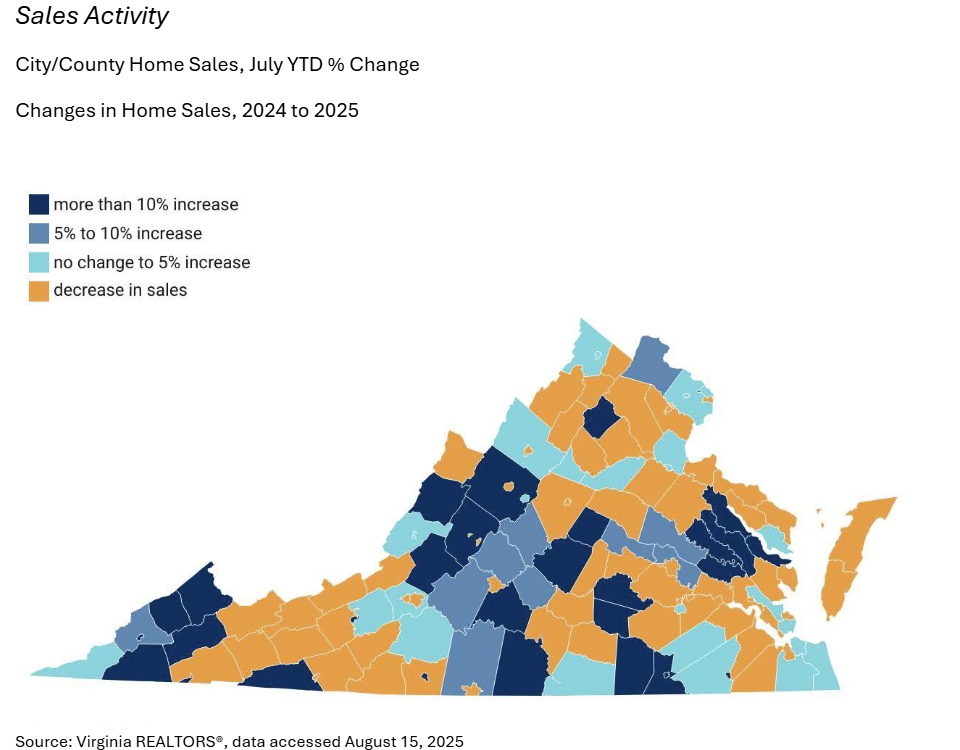
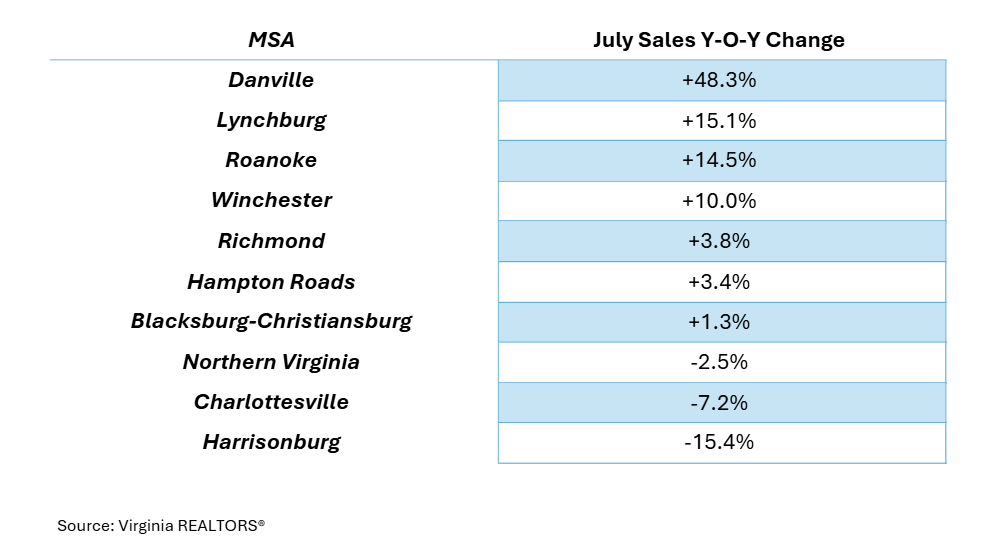
The number of home sales across Virginia surpassed last July. Statewide, there were 10,182 sales in Virginia in July, up 2.4% from a year ago. Although July saw an increase, total sales for the year so far remain somewhat steady compared to 2024, primarily because of the slow spring market. Buyers in the market remain cautious due to high mortgage rates and increased home prices that are pushing affordability out of reach. Metro areas like Danville (+48.3%), Roanoke (+14.5%), and Lynchburg (+15.1%) saw significant sales growth compared to last July. In contrast, markets such as Charlottesville (-7.2%), Harrisonburg (-15.4%), and Northern Virginia (-2.5%) experienced a decline in activity from the previous year.
Inventory levels have not yet reached our ideal state, but one would expect demand for housing to absorb the new supply entering the market. However, this hasn’t happened, which explains the sluggish market performance over the summer. Despite this trend, the median home price in Virginia continues to rise year-over-year. In the state, the median sales price reached $435,000 in July, up 2.1% or $9,000 from the year before. As of recently, the average 30-year fixed mortgage rate stands at 6.5%, which is also 0.15% higher than last year, according to Freddie Mac.
As Virginia’s housing market shifts from summer, the story continues to be one of contrast. While more homes available benefit buyers, they are still limited by borrowing costs and affordability challenges. Unless economic conditions change, sellers may need to adjust their pricing strategies if they struggle to sell their listings. Builders face similar issues, as new construction homes are taking longer to sell. If this trend persists, the gap between supply and restrained demand suggests the state’s market could become more cautious, with both buyers and sellers remaining patient.
You might also like…
Key Takeaways: November 2025 Virginia Home Sales Report
By Virginia REALTORS® - December 22, 2025
Key Takeaways In November, home sales activity was slower than the previous year, likely due to a combination of the beginning of holiday season along with overall economic… Read More
Look Who is Renting: 2024 Profile of Virginia Renters
By Dominique Fair - December 16, 2025
The rental market has shifted over the last year with both construction and rental prices slowing down, but even with these changes, the cost of housing remains high… Read More
Key Takeaways from NAR’s 2025 Profile of Home Buyers and Sellers
By Sejal Naik - December 8, 2025
The National Association of REALTORS® recently released its annual profile of home buyers and sellers. This report summarizes the results from a survey of home buyers and sellers… Read More