The Hidden Gap in Today’s Rental Market: National Low Income Housing Coalition GAP Report
May 19, 2025
The rental market has changed over the last few years with both rent prices and construction levels cooling down. Despite this, many renters, particularly those with lower incomes, are facing significant cost and supply problems. According to the latest GAP report published by NLIHC, there are 35 affordable and available rental units for every 100 extremely low-income renter households (those making 30% of the Area Median Income). This shortage is not just in a handful of states but in every state and major metropolitan area in the country. Let’s take a deeper look at the demographics of this renter population and how housing affordability is impacting them nationwide and in Virginia.
Affordable housing options are limited for low-wage renters
Extremely low-income renters are experiencing significant housing shortages compared to other income groups. There are only 7.1 million affordable rental units for this income group which consists of 10.9 million renters. That number falls even further when factoring in high income earners who occupy these rentals, leaving 3.8 million affordable and available units for low-income earners. This group is also facing income challenges with 87% being cost burdened (those spending more than 30% of income on housing) and 75% severely cost burdened (those spending more than 50% on housing). NLIHC also found that individuals needed to make $26.74 an hour to afford a one-bedroom apartment. At the current federal minimum wage of $7.25 an hour (In Virginia it is $12.41.) a worker would need to work 95 hours to afford a unit. Even if they can afford the rent, there is still the residual income burden with 100% of renters making less than $30,000 unable to afford necessities outside of rent.

Source: National Low Income Housing Coalition, 2023 ACS PUMS Data
Demographics of Extremely Low-Income Renters
The NLIHC report showed that 34% of extremely low-income renters are part of the labor force with 42% working 40 hours or more a week, and 33% working 20-39 hours a week. Those who are seniors (33%) and disabled (18%), also make up a significant proportion of this renter population. Many extremely low-income renters fall into one or more of these categories with 13% working while taking care of a child or household member with a disability while possibly being elderly or disabled themselves. Race is also an important demographic to look at within this renter group as households of color are more likely to rent and have lower incomes. Latino, Native Hawaiian Pacific Islander and American Indian/Alaskan Native households are twice as likely to be extremely low-income renters compare to their white counterparts.

Source: National Low Income Housing Coalition, 2023 ACS PUMS Data
Fewer affordable units and rising housing costs in Virginia
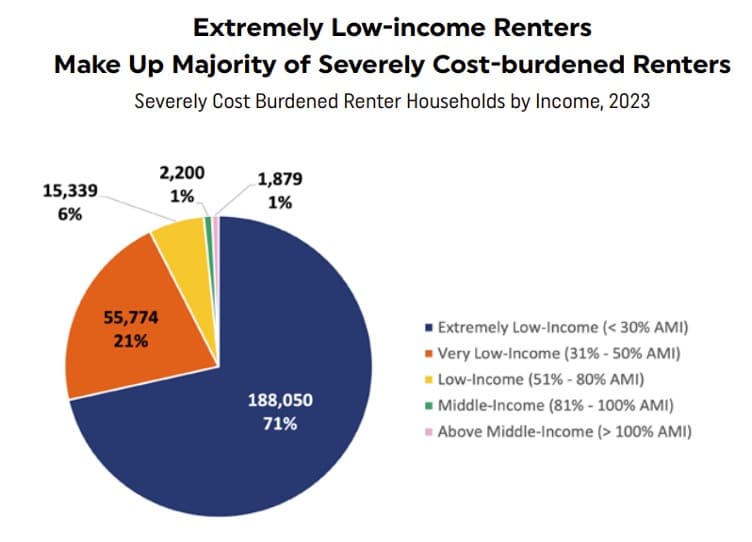
Like most other states, Virginia is also facing housing challenges among its lower-wage renter population. There are 243,675 extremely low-income households in the state, but there are only 79,517 affordable and available rental units. One of the main reasons for the shortage is that the cost of building and operating these units exceeds the rent that many low-wage earners can afford to pay. Another key factor is the wide gap between what renters make and the rising cost of housing. Per the GAP report, extremely low-income renters account for 71% of severely cost burdened households in Virginia. The average Fair Market Rent (FMR) is $1,573 for a two-bedroom rental, meaning that a renter would need to make $30.25/hr. or $62,925 a year to afford it. Minimum wage workers would be unable to afford this at the current state wage of $12.41, unless they worked 101 hours or 2.5 full-time jobs. Affordability is also an issue at the local level with Washington DC, Charlottesville, and Richmond being the most expensive metro areas in the state.
Source: NLIHC, 2023 ACS PUMS Data
Building affordable units for lower income renters should remain a priority in future multifamily projects. Greater housing stability and less rent burden can not only lead to better financial mobility for renters but also help grow the housing market and overall economy.
For more information on housing, demographic and economic trends in Virginia, be sure to check out Virginia REALTORS® other Economic Insights Blogs and our Data Page.
You might also like…
Understanding the Renter Lock-In Effect
By Dominique Fair - May 19, 2026
The lock-in effect has been a big topic over the last few years with rates hovering in the 6-7% range and home prices much higher than what they… Read More
Opportunity Zones in Virginia: What Every REALTOR® Should Know
By Sejal Naik - May 7, 2026
Established under the 2017 Tax Cuts and Jobs Act, Opportunity Zones (OZ) are a federal economic development and community development tax benefit designed to encourage long-term private investment… Read More
Highlights from the NAR 2026 Home Buyers and Sellers Generational Trends Report
By Dominique Fair - May 1, 2026
Every year the National Association of REALTORS® releases their Home Buyers and Sellers Generational Trends Report, highlighting housing trends and characteristics across different generations. Let’s explore some of… Read More