Key Takeaways: NLIHC 2025 National Renter Survey
September 23, 2026
The National Low Income Housing Coalition (NLIHC) released their first National Renter Survey highlighting renters’ decisions and experiences related to moving, housing costs and accessibility and habitability. Let’s look at some of the key takeaways from the report.
Affordability is Influencing Moving Decisions
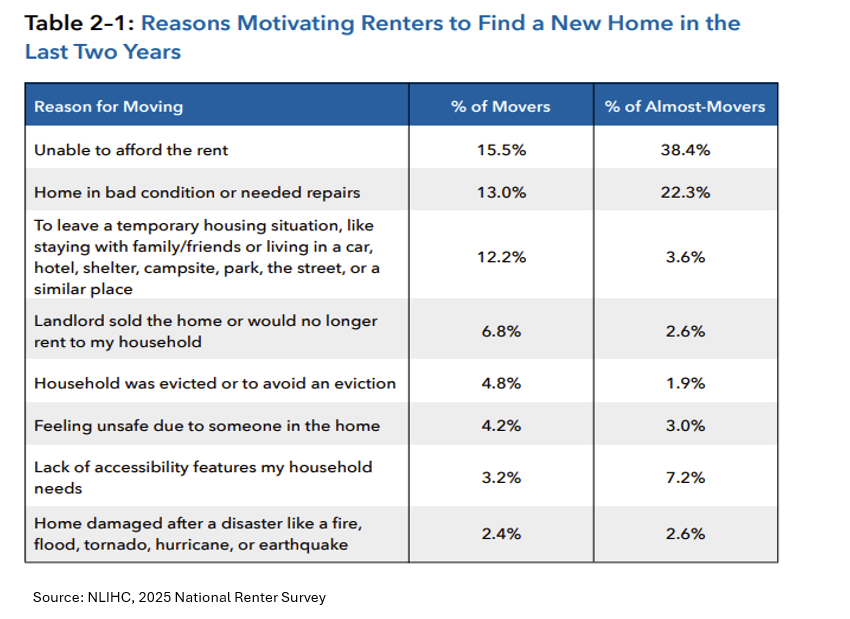
In 2025, 30 million adult renters in the U.S. moved to a different home at least once in the last two years per the National Renter Survey. There are many reasons motivating renters to move, one of which is looking for a better rental home, neighborhood, community or opportunities. Another factor is affordability, which is both a motivator and barrier for renters who have moved with the survey finding that 15.5% cited being unable to afford rent as a reason for finding a new home. This was also a strong reason for renters who considered moving over the last two years (38.4%). When searching for new housing, the most common challenge renters faced was finding a home with affordable rent (40.4%), followed by landlords requiring incomes higher than the monthly rent (24.4%). Household characteristics also impacted renters and their decision to move with the majority (78.6%), indicating that low or no credit score was the biggest difficulty they faced when renting a home and the reason their housing applications were denied (51%).
Rising Costs are Putting Pressure on Renters
Renter households have become increasingly cost burdened in the U.S. with 22.7 million renters, spending more than 30% of their income on housing. They are also charged for additional services related to renting such as pet rent or convenience fees that drive up the total rental costs. As a result, one in six renters have stated they “always” or “often” struggle to pay their rent on time. This disproportionally impacts those making $50,000 or less, Black renters, and those living with or having a disability or chronic health condition. Those struggling to pay rent on time have had to use a variety of ways to afford rent, whether that is working multiple jobs, using credit cards, taking out a loan or prioritizing rent over other bills. Renters have also turned to the government to help with higher housing costs. The NLIHC survey reported that 6.3 million renters received housing assistance last year, most of which was concentrated among those making $50,000 or less. Despite these methods, 54.8% of renters who struggled to pay rent stated they still could not pay some or all of it, were charged a late fee, or both.
Renters Need Safe and Accessible Housing
Finding accessible housing can be challenging for individuals with a disability or chronic health condition, with 56.3% of adult renters agreeing it is difficult according to the survey. Many rental homes do not have features such as grab bars in bathrooms, or single floors with no steps or an elevator, two commonly needed features. As a result, 65% of renters needing mobility features and 77.1% of renters who need sensory features live in homes that do not meet their needs. Alongside accessibility, safety is also important for residents but with the stock of rental homes in the U.S. getting older, many repairs and updates will be needed to ensure habitability. The National Renter survey reported that 3.6 million renters lived in homes that are moderately or severely inadequate due to habitability issues in 2023. The top three habitability issues renters reported were pests (24.8%) issues with electrical items (18.7%) and broken or missing essential fixtures or structures (18.1%).

Renters face a variety of issues when it comes to living and finding rental homes. The more we know about these issues the better equipped we are to address them and provide all renters with safe, affordable, and accessible housing.
For more information on housing, demographic, and economic trends in Virginia, be sure to check out Virginia REALTORS® other Economic Insights blogs.
You might also like…
Key Takeaways: August 2026 Virginia Home Sales Report
By Virginia REALTORS® - September 23, 2026
Key Takeaways Sales activity in many parts of the Commonwealth slowed down in August as mortgage rates continued to rise. There were 8,985 closed sales statewide, 438 fewer… Read More
A Snapshot of the Cost of Living in Virginia
By Abel Opoku-Adjei - September 10, 2026
The cost of living significantly influences where people decide to live, work, and buy homes. Virginia offers a diverse range of communities, from the more expensive suburbs of… Read More
From Pending to Closing: Why Housing Deals Fall Through
By Abel Opoku-Adjei - September 8, 2026
A home going under contract is an exciting milestone for buyers and sellers; however, a pending sale doesn’t always mean the sale will close. Between an accepted offer and closing day, various… Read More